Review the Phases of the Cell Cycle in Model 1
The jail cell is the basic structural and functional unit of whatsoever living being. It is the primal building block, which when combined with similar cells forms a tissue and organs. A cell comprises several organelles:
- Cytoplasm
- Cytoskeleton
- Endoplasmic reticulum (ER)
- Golgi apparatus
- Lysosomes and peroxisomes
- Mitochondria
- Nucleus
- Plasma membrane
- Ribosomes
The cell undergoes a series of events that result in the duplication of cell forth with the DNA. This is known as the cell bicycle. Allow us take a wait at the events taking place in the sectionalisation of prison cell during a cell cycle.
As well Read:Difference betwixt Karyokinesis and Cytokinesis
Cell Cycle Definition
"Cell bike refers to the series of events that take place in a cell, resulting in the duplication of Deoxyribonucleic acid and partitioning of cytoplasm and organelles to produce two girl cells."
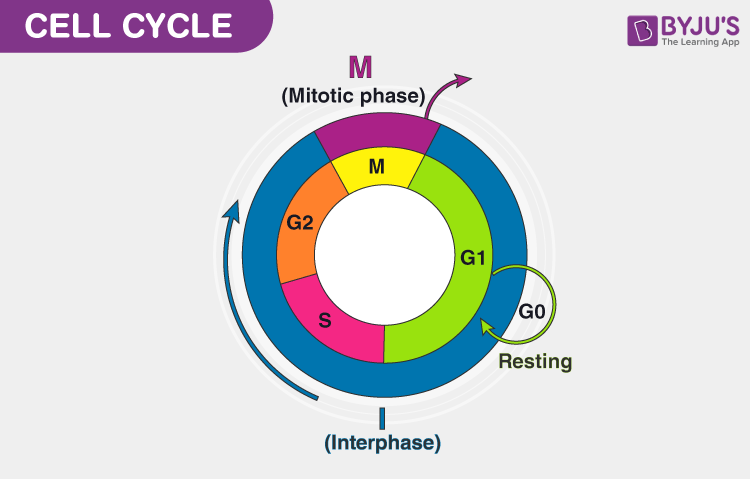
What is Cell Cycle?
The cell cycle was discovered past Prevost and Dumas (1824) while studying the cleavage of zygote of Frog.It is a series of stages a cell passes through, to divide and produce new cells.
This entire procedure where with the help of one single parent prison cell a new cell population grows and develops is known equally the cell wheel.
Also Read:Meiosis I
Phases of Cell Cycle
Jail cell cycle or jail cell division refers to the series of events that take place in a cell leading to its maturity and subsequent partitioning. These events include duplication of its genome and synthesis of the cell organelles followed by division of the cytoplasm .
Human cells exhibit typical eukaryotic cell cycle and take effectually 24 hours to consummate one cycle of growth and sectionalization. The duration of the cycle, however, varies from organism to organism and cell to prison cell.
A typical eukaryotic jail cell bicycle is divided into two main phases:-
Interphase
As well known as the resting phase of the jail cell bike; interphase is the time during which the cell prepares for sectionalization by undergoing both cell growth and DNA replication. Information technology occupies around 95% time of the overall cycle. The interphase is divided into 3 phases:-
- Thou ane phase (Gap 1) – G i phase is the stage of the cell between mitosis and initiation of replication of the genetic textile of the prison cell. During this phase, the prison cell is metabolically agile and continues to grow without replicating its Deoxyribonucleic acid.
- Due south phase (Synthesis) – Dna replication takes place during this phase. If the initial quantity of DNA in the cell is denoted every bit 2N , then after replication it becomes 4N . Yet the number of chromosomes does not vary, viz., if the number of chromosomes during G i phase was 2n , it will remain 2n at the end of Due south phase. The centriole also divides into two centriole pairs in the cells which contain centriole.
- One thousand 2 phase (Gap two) –During this stage, the RNA, proteins, other macromolecules required for multiplication of cell organelles, spindle formation, and cell growth are produced as the cell prepares to go into the mitotic phase.
Some cells like cardiac cells in the developed animals do not exhibit division and some others only divide to supercede those cells which have been either damaged or lost due to jail cell decease. Such cells which practice not divide farther attain an inactive G0 phase too known every bit quiescent phase after they leave the G 1 phase. These cells remain metabolically active but do not divide unless called upon to practice so.
M phase
This is the mitotic phase or the phase of the equational division as the cell undergoes a complete reorganization to give birth to a progeny that has the aforementioned number of chromosomes as the parent jail cell. The other organelles are besides divided as past the process of cytokinesis which is preceded by mitotic nuclear division. The mitotic phase is divided into 4 overlapping stages:-
- Prophase,
- Metaphase,
- Anaphase, and
- Telophase
Mitosis
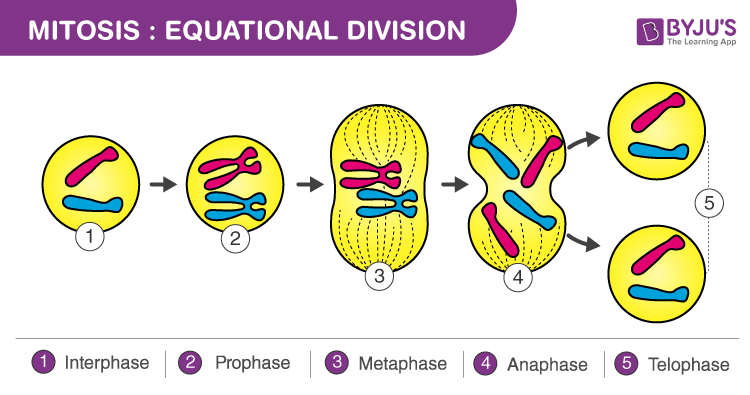
The process by which a eukaryotic cell separates the nuclear Dna and chromosomes and divides into two dissimilar only similar sets of nuclei is known as mitosis. The chromosomes are pulled autonomously by a mitotic spindle, which is a specialized structure consisting of microtubules.
Cytokinesis
In this phase, the cytoplasm of the cell divides. It begins as soon as the mitosis ends. Plant cells are much tougher than animal cells, as they take a rigid cell wall and high internal pressure. Thus, cytokinesis occurs in plant and animal cells differently.
Besides Read:Cell partitioning
Recommended Video:

To report in detail about the cell bike, its definition and dissimilar phases of prison cell bicycle, keep visiting BYJU'Due south website or download BYJU'S app for further reference.
Ofttimes Asked Questions
What do you sympathise by cell cycle?
Cell cycle refers to the series of events that results in the duplication of the cell alongwith the DNA.
What are the four major stages of mitosis?
The 4 important stages of cell cycle include:
- Interphase
- Prophase
- Metaphase
- Anaphase
- Telophase
- Cytokinesis
What are the unlike phases of a cell cycle:
The different phases of a cell cycle include:
- Interphase – This phase includes the G1 phase, S phase and the G2 phase.
- M phase – This is the mitotic phase and is divided into prophase, metaphase, anaphase and telophase.
- Cytokinesis – In this stage the cytoplasm of the prison cell divides.
Who discovered jail cell bike?
Walther Flemming discovered jail cell cycle in the 19th century. He was a professor at the Institute of Anatomy.
What is the importance of jail cell partition?
The cell division is important because of the following reasons:
- It helps in the survival and growth of organisms.
- Maintanence of chromosome number.
- Renewal of damaged cells
Which is the most important phase of cell wheel?
Interphase is the well-nigh important stage of cell cycle. The cell stays in the interphase for maximum periods. During this phase the cell prepares itself for partitioning. The cell undergoes jail cell growth and replication during this phase.
What is the significance of G1, Due south and G2 phases of the interphase?
- During the G1 phase the jail cell continues to grow merely does non replicate.
- During the Southward phase the Deoxyribonucleic acid of the cell replicates.
- During the G2 phase the RNA, proteins and other macromolecules required for mitotic division are produced past the jail cell.
pattersonupory1953.blogspot.com
Source: https://byjus.com/biology/cell-cycle-and-division/
0 Response to "Review the Phases of the Cell Cycle in Model 1"
Enregistrer un commentaire